
Micro Hubs and Spokes
Delivering the City


To open a phase of renewed posting here, I want to talk about a new junction I have been observing around the city to manage distribution. One of the key takeaways from my day with the driver in wholesale delivery was how arbitrarily irregular the built and lived environment is. This characteristic of life’s effect on logistics has given rise to the model of delivery I have observed over the last year in Manhattan, a micro hub and spoke system for neighborhood service.
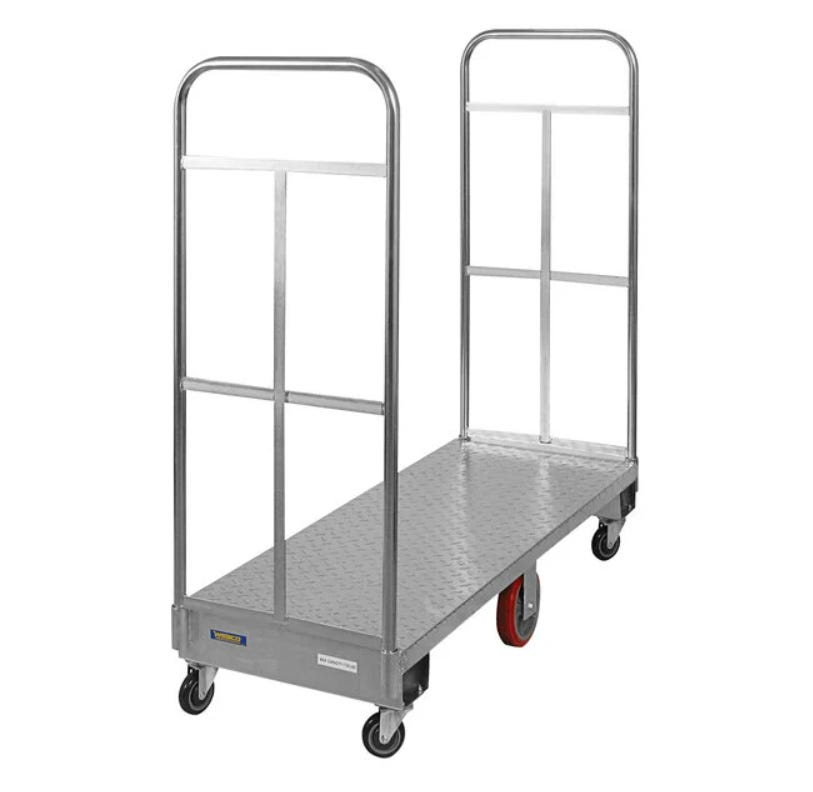
First, the problem. The world in which we live is complex and complicated to navigate, from roads, to entries, to inhabited spaces. In deliveries, during my day in the truck, this influenced route planning and the truck’s arrival approach to take into account how road design and access paths shaped choices. But most intricately, the challenges were manifest where the hand truck met the world. The last junction to retails nodes is an obstacle course. The are curbs, doors, arrow aisles, bumps, obstacles, and chaotic storage. It demands a human’s labor. Innovation to make the job better is to be found in the truck to hand truck junction and in better hand trucks.
The human solution to the environment figures in the innovative approach to residential deliveries in Manhattan. Addressing the complications of traffic and parking stresses in the process of moving a truck from point to point without investing in local warehousing or robotics, high density services have implemented what I would describe as the devolution of a distributed one-container warehouses to manage local hub and spoke deliveries in neighborhoods. In operation, the system itself is simple. Trucks park up at central points in residential-dense neighborhoods and then discharge individuals on foot and hand truck to their destinations. And here I would argue it needs a human not a robot for a variety of reasons. The sidewalks are a disaster of obstacles and disorder. Buildings have doors and stairs to enter, with access at the control of buzzers or doormen. There are myriad drop methods, either to a person, a foyer, or a secured box. And when the issues of scale and flexibility of the operation are factored in, these obstacles are best navigated and managed by this system of human operators.
…
We like to think we are in a novel era of personalized delivery. Sears modern homes would beg to differ. Rather, it is a ever looping cycle as models of distribution adjust to economic and social context. In this case, on top of being an interesting development in this history of deliveries, the case offers two critical points of consideration on innovation and labor.
On the matter of innovation, the stereotypical image of it is in a form of technological advance, revolutionary concept, or flashy technique. But I am constantly confronted in logistical history and practice that the most impressive advances are minor adjustments, bureaucratic refinement, or acts of human ingenuity. One example of the first type, for example, I am particularly fond of is the space-saving practice of squeezing loo roll tubes during WWII - at the scale of millions of rolls, even this modest size difference became meaningful. Here we see a novel practice being created out of the context and constraints of operations.
Of human labor, much of history is about how we have developed tools and the world for ease of the lived experience. And yet, it is never the case that labors are ever banished, merely displaced from one activity to another. As we are again in another age promising the release from the drudgery, either by autonomic actors or thinkers, it is difficult to buy fully into still another promise. Instead, it seems to me a ripe moment to elevate how we think about and treat human labor. In a discussion of the matter in geopolitical terms, former German Chancellor Olaf Schulz framed the issue around the respect society and government given to unglamorous labor. And where we understand respect* to include pay and benefits as well as interpersonal treatment, such a reorientation would be a significant innovation upon which further future advances that make lives better could be built.
The interactions of logistics and life creates reinforcing loops of influence between the two, shaping our experiences in myriad ways (eg cost, traffic, availability of goods) we may not always recognize. Nor are they necessarily organized beyond the urges of market interests, which further blurs them to our perception. But the more items we have in our lives - and the remains the human trend - the more such systems will work their influences.
Note:
*In my dissertation, I relied upon the mechanism of respect for service to build a reliable army during the American War for Independence. That respect was defined in tangible terms, such as pay, uniforms, feeding, and especially citizen-making land grants. In return for this social elevation, soldiers were expected to respect civilian authority and society via disciplined operation. It did not always work in practice, given logistical weaknesses, but the ethos was defined and serves well here.